

Medical review: Bryan Hayter, DVM | Owner & Medical Director, Desert Forest Animal Hospital
Last medically reviewed: September 2026
If your cat is repeatedly straining to urinate and producing little or no urine, treat this as an emergency.
A complete urethral blockage can rapidly cause kidney dysfunction, dangerous electrolyte abnormalities, abnormal heart rhythms, severe illness, and death if urine flow is not restored. Male cats are at particularly high risk.
During regular business hours, call (480) 488-2010 before arriving at Desert Forest Animal Hospital. If your cat may be completely unable to urinate and we are unavailable, seek an appropriate 24-hour emergency veterinary hospital rather than waiting for the next routine appointment.
Your cat keeps walking into the litter box.
He squats, strains, gets back out, then returns a few minutes later. Maybe you see a few drops of urine. Maybe you see nothing at all. He may lick himself, cry, hide, vomit, or simply seem uncomfortable.
It is easy to mistake this for constipation.
But in a male cat, repeated attempts to urinate with little or no urine can mean a urethral obstruction—one of the most time-sensitive emergencies in feline medicine.
At Desert Forest Animal Hospital in Cave Creek, urinary problems are among the conditions that may require same-day urgent veterinary evaluation .
This guide explains how to recognize a possible urinary blockage, why it becomes dangerous, how veterinarians determine whether a cat is actually obstructed, what treatment may involve, and what owners can do to reduce the risk of another urinary episode.
What Is a Urinary Blockage in a Cat?
A urinary blockage occurs when urine cannot pass normally through the urethra—the narrow tube that carries urine from the bladder to the outside of the body.
The medical term is urethral obstruction.
Obstruction may be caused by material within the urethra or by functional narrowing and spasm associated with inflammation. Possible contributors include:
- Urethral plugs containing inflammatory material, mucus, cells, and mineral material
- Urinary stones
- Severe urethral inflammation and swelling
- Urethral spasm
- Scar tissue or stricture
- Less commonly, tumors or other structural abnormalities
The Cornell Feline Health Center identifies urethral obstruction as the most dangerous complication of feline lower urinary tract disease and emphasizes that affected cats require immediate veterinary attention.
Why Are Male Cats More Likely to Become Blocked?
Both male and female cats can develop bladder inflammation, urinary stones, blood in the urine, painful urination, and other lower urinary tract problems.
However, male cats are much more vulnerable to complete urethral obstruction because the male urethra is longer and becomes particularly narrow near the end of the urinary tract.
Inflammatory material, crystals, mucus, small stones, or swelling that might irritate a female cat’s bladder can physically obstruct the narrower male urethra.
Cornell notes that male and neutered male cats are at increased risk because of this anatomy. That does not mean neutering itself should be assumed to have caused the urinary disease.
What Are the Signs of a Blocked Cat?
The earliest signs can look nearly identical to other forms of feline lower urinary tract disease.
Watch particularly for:
- Repeated trips to the litter box
- Straining or squatting for prolonged periods
- Producing only drops of urine
- Producing no visible urine
- Crying, growling, or vocalizing while attempting to urinate
- Blood in the urine
- Urinating outside the litter box
- Repeatedly licking the penis or genital area
- Restlessness or inability to become comfortable
- Hiding
- Loss of appetite
- Vomiting
- Lethargy or weakness
- A tense or painful abdomen
- Collapse in advanced cases
A cat does not have to be collapsed or critically ill before a blockage is dangerous. Early in the process, the cat may still be alert and walking around.
Can a Blocked Cat Still Pass a Few Drops of Urine?
Yes.
This is one of the most important points for cat owners to understand.
Seeing a few drops in the litter box does not reliably prove that the urethra is adequately open. A partially obstructed cat may pass very small amounts of urine while remaining at risk of progressing to complete obstruction.
Likewise, blood, moisture, or a small wet spot in the litter box does not tell you whether the bladder is emptying normally.
If a male cat is repeatedly straining and producing only tiny amounts, he should be evaluated promptly.
Why Is a Cat Urinary Blockage So Dangerous?
Urine is how the body eliminates many metabolic waste products and regulates water, acid-base balance, and important electrolytes.
When urine cannot leave the bladder, pressure builds within the urinary system and the kidneys can no longer eliminate waste normally.
This can cause postrenal azotemia—a buildup of nitrogenous waste products in the blood because urine outflow is obstructed.
Another major concern is hyperkalemia, an abnormally high blood potassium concentration. Severe hyperkalemia can interfere with the electrical activity of the heart and contribute to dangerous arrhythmias.
As the obstruction continues, a cat may develop:
- Progressive kidney dysfunction
- Dehydration
- Acid-base abnormalities
- Dangerous potassium elevations
- Abnormal heart rhythms
- Vomiting
- Profound lethargy or depression
- Low body temperature
- Shock
- Collapse
- Death
The Merck Veterinary Manual describes complete urethral obstruction as an emergency requiring stabilization and relief of the obstruction.
Is My Cat Constipated or Trying to Urinate?
This distinction is difficult enough that even experienced cat owners sometimes get it wrong.
A cat straining to defecate and a cat straining to urinate may both crouch repeatedly in the litter box.
Merck specifically notes that owners may mistake urinary obstruction for constipation.
Useful clues include checking whether you are seeing normal-sized urine clumps and whether the cat is repeatedly assuming a urination posture without producing an appropriate amount.
However, do not delay veterinary care trying to prove which problem it is. If a male cat is repeatedly straining in the litter box and you cannot confirm normal urination, treat urinary obstruction as a possibility.
What Is Feline Lower Urinary Tract Disease?
Feline lower urinary tract disease (FLUTD) is not one specific diagnosis. It is a broad term describing disorders affecting the urinary bladder and urethra.
Cats with different diseases may show almost identical symptoms.
Possible causes include:
- Feline idiopathic cystitis
- Urethral obstruction
- Bladder or urethral stones
- Urethral plugs
- Bacterial urinary tract infection
- Anatomic abnormalities
- Trauma
- Less commonly, urinary tumors
According to Merck’s review of feline lower urinary tract disease , feline idiopathic cystitis is the most common diagnosis among cats with lower urinary tract signs.
What Is Feline Idiopathic Cystitis?
Feline idiopathic cystitis, often abbreviated FIC, is a painful inflammatory condition of the bladder in which routine diagnostic testing does not identify another specific cause.
“Idiopathic” means that no single underlying cause has been identified.
FIC is associated with complex interactions among the bladder, nervous system, stress response, environment, and individual susceptibility.
A cat with FIC may strain, urinate frequently, pass blood, urinate outside the litter box, or appear painful.
The challenge is that those same signs can occur with a true urethral obstruction.
That is why an owner should not assume:
“He has had cystitis before, so this is probably just another episode.”
A male cat with recurrent lower urinary signs can still become blocked.
Does Straining Mean My Cat Has a Urinary Tract Infection?
Not necessarily.
“Urinary symptoms” and “urinary tract infection” are not interchangeable terms in cats.
Painful urination, blood in the urine, frequent litter-box trips, and urinating outside the box can occur with inflammation, stones, obstruction, or other urinary disorders even when no bacterial infection is present.
Urinalysis and, when appropriate, urine culture help determine whether bacteria are actually involved.
This is why simply giving leftover antibiotics or assuming every urinary episode is a UTI is not appropriate.
How Does a Veterinarian Determine Whether a Cat Is Blocked?
The first priorities are determining whether urine flow is obstructed and whether the cat is medically stable.
The veterinarian will evaluate the cat’s history, behavior, hydration, heart rate, temperature, circulation, abdomen, and urinary bladder.
An obstructed cat often has a bladder that is enlarged, firm, and painful, although examination findings must be interpreted in the context of the entire patient.
Depending on the cat’s condition, additional testing may include:
- Blood chemistry
- Kidney values
- Electrolytes, particularly potassium
- Urinalysis
- Urine culture when indicated
- Abdominal X-rays
- Ultrasound
- Electrocardiogram monitoring in cats with significant electrolyte abnormalities
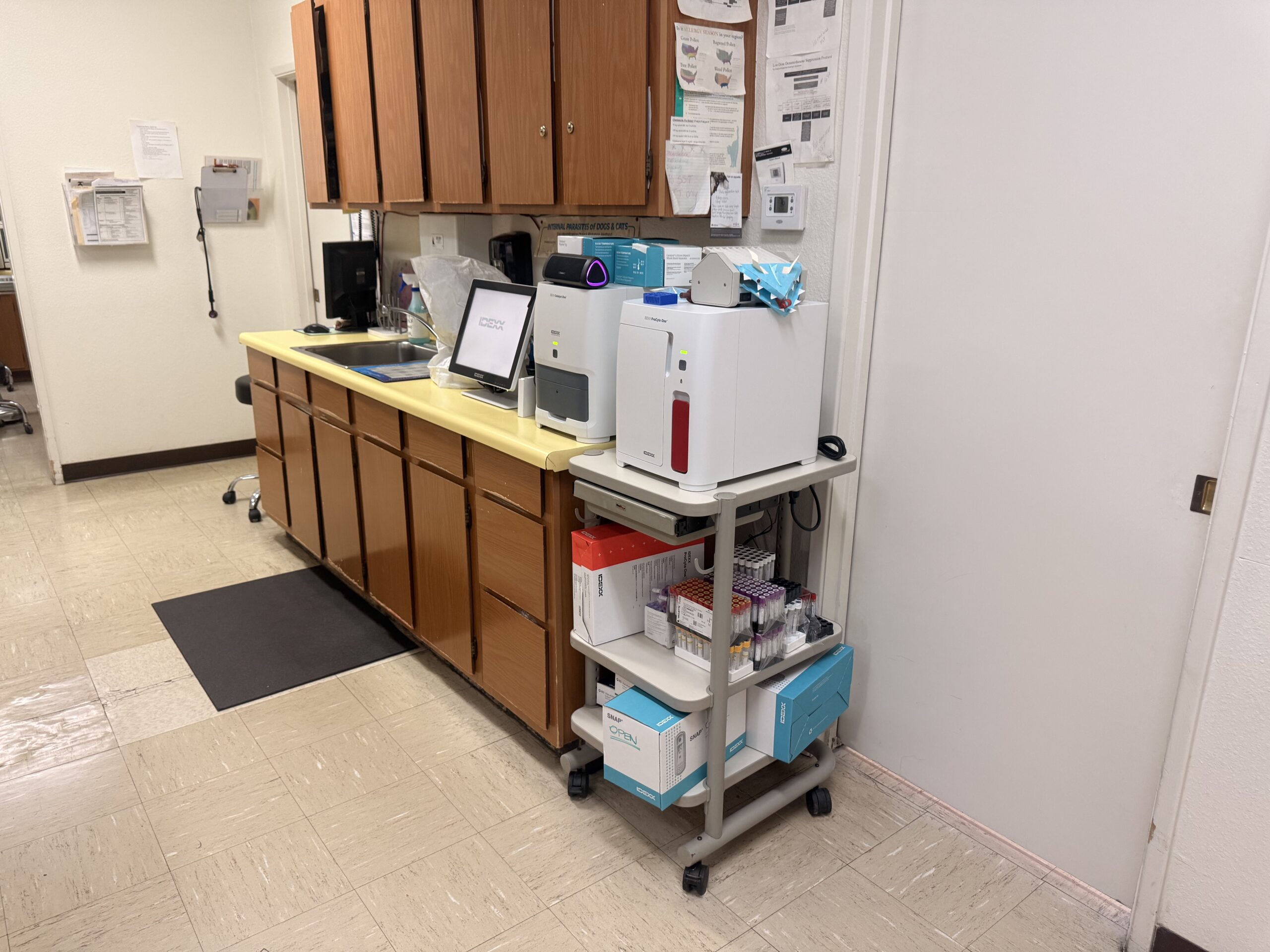
At Desert Forest Animal Hospital, our veterinary diagnostic and blood-work services may be incorporated into the evaluation when medically appropriate.
Why Might a Cat Need Blood Work for a Urinary Blockage?
The problem is not limited to the bladder.
Once urinary outflow is significantly obstructed, important changes can occur throughout the body.
Blood testing helps evaluate:
- Kidney function
- Potassium concentration
- Other electrolyte abnormalities
- Hydration-related changes
- Acid-base consequences
- Other abnormalities that may affect stabilization or anesthesia
A cat that appears relatively stable externally can still have clinically important laboratory changes.
Why Are X-Rays or Ultrasound Sometimes Needed?
A urinary obstruction tells us that urine is not flowing normally. It does not automatically tell us why.
Imaging can help identify urinary stones and other structural abnormalities and may influence both immediate treatment and longer-term prevention.
Cornell notes that diagnostic evaluation of feline lower urinary signs may include blood work, X-rays, abdominal ultrasound, and/or urine culture depending on the suspected cause.
How Is a Blocked Cat Treated?
Treatment depends on the cat’s condition at presentation.
A critically ill cat may need medical stabilization before the obstruction can safely be relieved.
Treatment may involve:
- Intravenous access
- IV fluid therapy
- Pain management
- Treatment of dangerous electrolyte abnormalities when present
- Sedation or anesthesia
- Urinary catheterization to restore urine flow
- Bladder decompression in selected cases
- Urinary catheter maintenance for continued drainage when indicated
- Monitoring urine production
- Repeat laboratory testing
- Hospitalization
The specific approach depends on the severity and duration of obstruction, cardiovascular stability, laboratory findings, cause of obstruction, and response to treatment.
Why Does Unblocking Usually Require Sedation or Anesthesia?
Passing a urinary catheter through an inflamed, painful, obstructed male urethra is not a procedure that should be performed on a fully conscious struggling cat.
Sedation or anesthesia can provide pain control, allow muscle relaxation, reduce distress, and help the veterinary team perform catheterization more safely.
Merck recommends relieving feline urethral obstruction under general anesthesia whenever possible because traumatic catheterization can contribute to urethral injury, tearing, spasm, or later stricture.
What Happens After the Cat Is Unblocked?
Restoring urine flow is critical, but it is not necessarily the end of treatment.
After obstruction is relieved, some cats develop post-obstructive diuresis.
This means the kidneys begin producing unusually large volumes of urine as the body attempts to eliminate accumulated water and waste products.
If substantial, this can lead to dehydration and additional electrolyte disturbances unless fluid balance and urine production are monitored carefully.
This is one reason cats with significant obstruction commonly require continued observation after urine flow has been restored.
Will My Cat Need Surgery?
Most first-time urethral obstructions are initially managed medically with stabilization and catheterization when that is possible.
Surgery may be considered in selected situations, including recurrent obstruction or an anatomic problem that cannot be managed adequately through medical treatment.
One procedure sometimes considered for cats with repeated urethral obstruction is a perineal urethrostomy (PU).
PU surgery creates a wider permanent urinary opening by removing the narrowest portion of the male urethra.
It can substantially reduce the risk of obstruction at that narrow location, but it does not cure every cause of feline lower urinary tract disease. A cat can still develop bladder inflammation, urinary stones, infection, or other urinary disease.
Can I Treat a Possible Urinary Blockage at Home?
No.
There is no safe home method to determine that a repeatedly straining male cat is definitely not obstructed.
Do not:
- Wait overnight to see whether the cat improves
- Press or squeeze the abdomen trying to empty the bladder
- Attempt to express a painful bladder
- Give another pet’s medication
- Give leftover antibiotics
- Assume a few drops of urine mean the cat is safe
- Assume straining is constipation without veterinary evaluation
If your cat cannot pass a normal amount of urine, veterinary examination is the appropriate next step.
Should I Give My Cat Pain Medicine at Home?
Do not give human pain medication unless a veterinarian specifically directs you to do so.
Several common human medications can be extremely dangerous to cats, and a medication given at home can complicate treatment without relieving the underlying obstruction.
Why Do Some Cats Become Blocked Again?
A previous urinary obstruction increases concern for recurrence.
The prevention plan should therefore be based on the cause or suspected contributors identified during evaluation.
Depending on the individual cat, prevention may address:
- Water intake
- Diet
- Urine concentration
- Urinary stone composition
- Body weight
- Stress and environmental factors
- Litter-box access
- Household conflict
- Activity and enrichment
- Medication when appropriate
- Follow-up urinalysis or imaging
There is no single urinary diet, supplement, medication, or environmental change that is correct for every cat with lower urinary tract disease.
Water Intake and Feline Urinary Health
Increasing moisture intake is commonly part of urinary-disease management because producing more dilute urine may be beneficial for selected cats and urinary disorders.
Strategies may include:
- Feeding an appropriate canned or higher-moisture diet when recommended
- Providing multiple fresh water locations
- Using wide, clean bowls
- Trying a water fountain if the cat prefers moving water
- Separating food and water resources when that encourages drinking
Dietary recommendations should be individualized, particularly when a cat has documented urinary stones, kidney disease, another chronic illness, or a prescription therapeutic diet.
Stress Can Matter in Feline Urinary Disease
Stress is not simply an emotional issue in cats with feline idiopathic cystitis. There is a recognized relationship between environmental stress, neurohormonal responses, and recurrent lower urinary tract signs in susceptible cats.
Potential stressors may include:
- Conflict with another cat
- Moving
- Schedule changes
- New pets or people
- Too few litter boxes
- Poor litter-box placement
- Limited hiding or resting areas
- Insufficient opportunities for play and predatory behavior
Cornell recommends environmental enrichment and modification as part of management for cats with feline idiopathic cystitis.
How Many Litter Boxes Should I Have?
For multi-cat households, resource competition can contribute to stress.
A commonly used starting point is one litter box per cat plus one additional box, distributed through different accessible areas rather than clustering every box in one location.
Boxes should be kept clean and located where a cat can use them without being cornered, ambushed, or disturbed by another animal.
Fear Free-Informed Care for Cats With Urinary Pain
Cats with bladder or urethral pain may be much more frightened or defensive than they are during routine veterinary visits.
Dr. Quinn Bauer, DVM is a Fear Free Certified veterinarian at Desert Forest Animal Hospital. Our team incorporates Fear Free veterinary principles whenever the cat’s medical condition permits.
For an urgent urinary patient, that may involve thoughtful handling, reducing unnecessary restraint, pain control, efficient diagnostic planning, or sedation when it provides safer and more humane care.
However, medical urgency comes first. A blocked cat cannot safely wait for gradual acclimation when immediate stabilization or urinary decompression is necessary.
Cat owners can also read our detailed guide to Fear Free veterinary care for cats in Cave Creek .
Cat Urinary Emergency Care in Cave Creek, Carefree & North Scottsdale
Desert Forest Animal Hospital provides same-day urgent veterinary evaluation during regular business hours for many sick and injured dogs and cats when staffing, capacity, and the patient’s medical needs allow.
Our hospital is located at:
Desert Forest Animal Hospital
6554 E Cave Creek Road
Cave Creek, AZ 85331
(480) 488-2010
We regularly care for cats from Cave Creek, Carefree, Desert Mountain, North Scottsdale, Tatum Ranch, Terravita, Desert Hills, Anthem, and surrounding North Valley communities.
Families living nearby can also learn more about veterinary care near Carefree, Arizona .
DFAH is not a 24-hour emergency hospital. If your cat may be completely blocked and we cannot evaluate your pet promptly, seek an appropriate 24-hour emergency facility rather than delaying treatment.
When Should I Call Right Now?
Call promptly if your cat is repeatedly straining to urinate, producing only tiny amounts, crying in the litter box, vomiting, becoming lethargic, or showing increasing abdominal discomfort.
Seek immediate emergency veterinary care if your cat:
- Cannot pass urine
- Is collapsing or profoundly weak
- Is repeatedly vomiting while straining to urinate
- Is minimally responsive
- Develops severe breathing difficulty
- Appears rapidly worse
Do not wait for the cat to stop eating, collapse, or appear critically ill before seeking help.
Frequently Asked Questions About Urinary Blockage in Cats
How can I tell if my male cat is blocked?
Repeated attempts to urinate with little or no urine are the most important warning sign. Affected cats may also vocalize, lick the genital area, hide, vomit, stop eating, or become progressively weak. A veterinarian must examine the bladder and patient to determine whether urine flow is obstructed.
Can a blocked cat still pee a little?
Yes. A partially obstructed cat may pass drops or very small amounts of urine. Seeing some moisture in the litter box does not guarantee that the bladder is emptying adequately.
Why does my cat keep going to the litter box but nothing comes out?
Possible causes include painful bladder inflammation, urinary stones, urethral obstruction, and other lower urinary tract disorders. In a male cat, inability to produce a normal amount of urine should be treated as a possible urethral obstruction until a veterinarian determines otherwise.
Can a urinary blockage look like constipation?
Yes. Cats with urinary obstruction may repeatedly squat and strain in a way that looks like difficulty passing stool. If you cannot confirm that a male cat is urinating normally, seek veterinary evaluation rather than assuming constipation.
How quickly can a urinary blockage become dangerous?
A complete urethral obstruction can cause rapidly progressive kidney dysfunction, toxin accumulation, and dangerous electrolyte abnormalities. Cats can deteriorate substantially over a short period, so suspected obstruction requires immediate veterinary attention.
What causes urinary blockage in male cats?
Possible causes include urethral plugs, inflammatory debris, urinary stones, severe inflammation and spasm, strictures, and less commonly other structural disease. Male cats are particularly susceptible because their urethra is long and narrow.
Does urinary blockage mean my cat has crystals?
No. Crystals or mineral material may be involved in some cats, but urethral obstruction can also occur with inflammatory plugs, stones, swelling, spasm, or other causes. A urinalysis and imaging may be needed to determine what contributed to the episode.
Is a cat urinary blockage the same as a UTI?
No. Urinary tract infection is only one possible cause of urinary signs in cats. Feline idiopathic cystitis, urinary stones, urethral plugs, and obstruction can produce similar symptoms without a bacterial infection.
Will antibiotics unblock my cat?
No. Antibiotics do not physically relieve a urethral obstruction. A blocked cat requires veterinary evaluation and restoration of urine flow. Antibiotics are used only when a bacterial infection is appropriately suspected or documented.
Will my cat have to stay in the hospital after being unblocked?
Many cats require hospitalization after relief of an obstruction so urine output, hydration, kidney values, electrolytes, pain, and the ability to urinate normally can be monitored. The duration depends on the severity of illness and the individual patient’s response.
Can urinary blockage happen again?
Yes. Recurrence is possible. Follow-up care may include dietary changes, increasing water intake, environmental modification, weight management, medication, repeat urine testing, or imaging depending on the suspected cause.
Does a urinary diet prevent every future blockage?
No single diet prevents every cause of urethral obstruction. Therapeutic urinary diets can be very useful for selected cats, particularly when urine composition or certain stone types are involved, but prevention should be individualized according to the diagnosis.
Should I wait until morning if my cat is still alert?
Not if your cat is repeatedly straining and producing little or no urine. A blocked cat may still be alert early in the process. Waiting for severe lethargy, vomiting, or collapse can allow a treatable emergency to become much more dangerous.
Trusted Feline Urinary Health Resources
- Cornell Feline Health Center — Feline Lower Urinary Tract Disease
- Cornell Feline Health Center — Bladder and Kidney Stones
- Merck Veterinary Manual — Urethral Obstruction
- Merck Veterinary Manual — Lower Urinary Tract Disease in Cats
Do Not Wait for a Blocked Cat to Look Critically Ill
A cat that repeatedly enters the litter box but produces little or no urine is giving you important information.
The safest question is not:
“Can I wait and see whether this gets better?”
It is:
“Can I confirm that my cat is emptying his bladder normally?”
If the answer is no, prompt veterinary evaluation is warranted.
Desert Forest Animal Hospital provides same-day urgent veterinary care in Cave Creek during regular business hours when staffing, capacity, and the patient’s medical needs allow.
Call (480) 488-2010 before arriving with a possible urinary emergency.
If your cat needs immediate treatment when DFAH is unavailable, seek an appropriate 24-hour emergency veterinary hospital.
If finances are part of treatment planning, you can also review our veterinary payment options, CareCredit, and Scratchpay information .
New to our hospital? Visit the Desert Forest Animal Hospital New Client Center .
Medical Review
Bryan Hayter, DVM
Owner & Medical Director
Desert Forest Animal Hospital
Cave Creek, Arizona
This article provides general educational information and does not replace veterinary examination, diagnostic testing, or individualized medical treatment. A cat that may be unable to urinate normally requires prompt veterinary evaluation. Do not delay emergency care while waiting for an online response.