
Bad breath may be the first dental problem a pet owner notices, but it is far from the only sign of oral disease.
Dogs and cats are remarkably good at continuing to eat, play, and interact normally despite significant dental pain. A pet can have periodontal disease, a fractured tooth, a tooth-root infection, feline tooth resorption, or another painful oral condition without crying, refusing food, or showing an obvious problem.
That is why veterinary dentistry should not be reduced to the question:
“Does my pet have enough tartar to need a cleaning?”
A more useful question is:
“Is there disease or pain in my pet’s mouth that needs to be diagnosed and treated?”
At Desert Forest Animal Hospital in Cave Creek, we provide professional veterinary dental care for dogs and cats, including oral examinations, professional dental cleaning, intraoral dental X-rays, pain management, and individualized treatment planning.
We care for dogs and cats from Cave Creek, Carefree, Desert Mountain, North Scottsdale, Tatum Ranch, Terravita, Desert Hills, Anthem, and surrounding North Valley communities.
Learn more about veterinary dental care at Desert Forest Animal Hospital →
A Dental Cleaning Is Not Just About Removing Tartar
One of the most important concepts in veterinary dentistry is that the amount of visible tartar does not reliably tell us how healthy the tissues beneath the gumline are.
Periodontal disease develops when inflammation and infection damage the structures supporting a tooth, including the gingiva, periodontal ligament, and surrounding alveolar bone.
The AAHA Dental Care Guidelines for Dogs and Cats emphasize that dental disease should be evaluated by looking at the health of the teeth, gums, supporting tissues, and structures beneath the gumline—not simply by judging how much calculus is visible.
A tooth can look relatively normal above the gumline while clinically important disease is developing around the root.
For this reason, a comprehensive veterinary dental assessment may include:
- An awake oral examination
- A complete anesthetized oral examination
- Periodontal probing
- Full-mouth intraoral dental radiographs
- Dental charting
- Cleaning above and below the gumline
- Polishing
- Treatment of diseased teeth when indicated
1. Persistent Bad Breath
Persistent bad breath—called halitosis—should not automatically be dismissed as normal “dog breath” or “cat breath.”
A temporary odor after eating may be harmless, but chronically foul breath can accompany:
- Plaque and bacterial biofilm
- Gingivitis
- Periodontal disease
- An infected or non-vital tooth
- Retained food or foreign material
- Oral inflammation
- Some oral masses or tumors
Bad breath alone does not tell us which problem is present or how advanced it may be.
Breath that suddenly becomes significantly worse—particularly when accompanied by swelling, bleeding, drooling, reduced appetite, or difficulty chewing—deserves veterinary evaluation.
2. Yellow or Brown Tartar on the Teeth
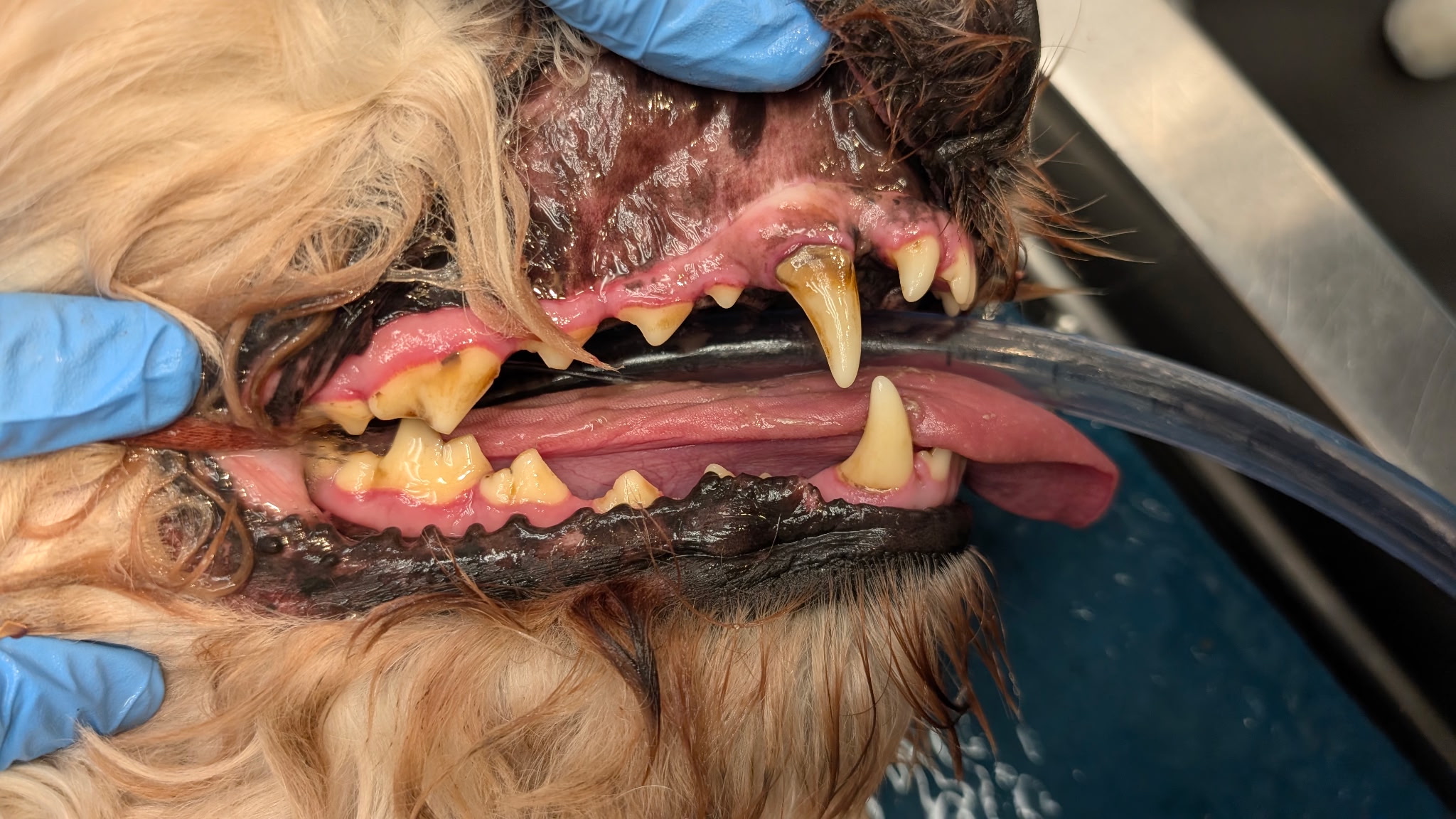
Plaque is a soft bacterial biofilm that begins accumulating on teeth after cleaning. When plaque mineralizes, it becomes hard dental calculus, commonly called tartar.
Owners commonly notice yellow, tan, or brown material near the gumline, particularly on the canine teeth and back teeth.
Visible tartar is useful information, but it has important limitations.
You cannot accurately stage periodontal disease simply by looking at the visible surface of a tooth.
Veterinary periodontal assessment may consider findings such as:
- Periodontal pocket depth
- Gingival recession
- Attachment loss
- Furcation exposure
- Tooth mobility
- Bone loss identified on dental radiographs
Some pets with dramatic tartar have relatively limited attachment loss, while another pet with less visible calculus may have significant disease beneath the gumline.
3. Red, Swollen, Receding, or Bleeding Gums
Healthy gingiva should not be markedly red, swollen, or prone to spontaneous bleeding.
Inflamed gums may indicate gingivitis, which is inflammation without periodontal attachment loss, or more advanced periodontitis, in which the tissues supporting the tooth have been damaged.
You may notice:
- A bright red line along the gum margin
- Swollen gum tissue
- Gums receding away from a tooth
- Blood on toys
- Blood on a toothbrush
- Bleeding around the teeth
Gingivitis may improve when plaque and inflammation are appropriately controlled. Once periodontal attachment and supporting bone have been lost, however, the disease is more advanced and requires an individualized treatment plan.
Do not force open the mouth of a pet who appears painful, frightened, or likely to bite.
4. Drooling More Than Usual
Some breeds and individual pets naturally drool more than others. A new or unexplained increase in salivation, however, can be a sign of oral discomfort.
Possible causes include:
- Periodontal disease
- A fractured tooth
- Tooth-root infection
- Feline tooth resorption
- Oral ulceration
- A foreign object
- An oral mass
- Trauma
- Nausea or another non-dental illness
Blood-tinged saliva, markedly foul-smelling saliva, or drooling combined with facial swelling or difficulty eating warrants prompt evaluation.
5. Dropping Food, Chewing Slowly, or Chewing on One Side
Pets with dental pain do not always stop eating.
Instead, they often adapt how they eat.
You may notice that your dog or cat:
- Picks up food and drops it
- Chews on only one side
- Takes longer to finish meals
- Swallows kibble with little chewing
- Approaches food eagerly and then hesitates
- Moves food around the mouth unusually
- Tilts the head while chewing
Watching how your pet eats can provide more useful information than simply checking whether the bowl eventually becomes empty.
6. Suddenly Avoiding Kibble, Hard Treats, or Favorite Chew Toys
A pet that suddenly prefers softer food, refuses crunchy treats, or loses interest in a previously favorite chew may be trying to protect a painful tooth or area of the mouth.
A normal appetite does not rule out dental pain.
Dogs and cats can continue eating despite substantial oral disease because hunger remains a powerful motivation.
A change from enthusiastically chewing hard treats to swallowing food whole or choosing only soft food deserves attention.
7. Pawing at the Mouth, Face Rubbing, or Resisting Facial Touch
Oral pain may appear as a behavior change rather than appetite loss.
Possible signs include:
- Pawing at the mouth
- Rubbing the muzzle against furniture or carpet
- Pulling away when the face is touched
- Resisting tooth brushing
- Becoming irritable when the head is handled
- Suddenly losing interest in favorite toys
Cats may be particularly subtle.
A cat with oral pain may:
- Chatter or jerk the jaw while eating
- Turn the head while chewing
- Drop food
- Hide more often
- Groom less
- Become irritable
- Approach food but then walk away
8. A Broken, Loose, Worn, or Discolored Tooth
A damaged tooth deserves evaluation even when your pet seems comfortable.
Tooth fractures range from superficial enamel injuries to fractures that expose the pulp—the living tissue containing nerves and blood vessels inside the tooth.
When the pulp is exposed, oral bacteria can enter the tooth and contribute to inflammation, pulp death, and infection around the root.
Dogs commonly fracture teeth while chewing very hard objects such as:
- Antlers
- Hard bones
- Rocks
- Very rigid toys
- Hard nylon-type objects
- Cage or fence material
A tooth that becomes gray, purple, pink, brown, or unusually dark may also be abnormal. Color change after trauma can indicate injury to the pulp.
Loose teeth in an adult dog or cat are also abnormal and may indicate advanced periodontal attachment loss, trauma, or another oral problem.
Depending on the tooth and diagnosis, treatment may include extraction, monitoring, or specialty treatment such as root-canal therapy.
9. Facial Swelling or Swelling Beneath an Eye
Swelling along the muzzle, jaw, or beneath an eye can be associated with a tooth-root infection, although tumors, trauma, salivary disease, insect stings, and other conditions can produce similar swelling.
A classic example is swelling beneath the eye associated with disease involving an upper cheek tooth. However, location alone cannot establish which tooth—or whether a tooth at all—is responsible.
New facial swelling should not simply be watched at home for several days.
If your dog or cat develops sudden facial or jaw swelling, significant oral pain, active bleeding, or difficulty eating, call Desert Forest Animal Hospital at (480) 488-2010 during regular hospital hours.
Our team can discuss what you are seeing and help determine whether your pet should be evaluated at Desert Forest Animal Hospital or whether the symptoms require a 24-hour emergency facility.
Difficulty breathing, major facial trauma, uncontrolled bleeding, collapse, or inability to close the mouth normally may require immediate emergency care.
Learn more about urgent veterinary care at Desert Forest Animal Hospital →
10. Your Veterinarian Finds Disease During a Wellness Examination
Dental disease is frequently discovered before the family notices anything abnormal at home.
During a routine preventive veterinary examination, your veterinarian may identify:
- Gingivitis
- Dental calculus
- A fractured tooth
- A discolored tooth
- Tooth mobility
- Gingival recession
- A retained deciduous tooth
- A missing tooth that may actually be unerupted
- An oral mass
- A painful area
- Evidence suggesting feline tooth resorption
An awake examination is extremely valuable, but it has important limitations.
A complete periodontal assessment requires evaluation beneath the gingiva and around the entire tooth. Periodontal probing of painful structures and diagnostic intraoral dental radiographs require anesthesia.
Why Dental X-Rays Matter So Much
A large portion of every tooth is hidden below the gumline.
That means even an experienced veterinarian cannot determine the health of every root and supporting structure by looking at the crown alone.
Intraoral dental radiographs can reveal:
- Bone loss around teeth
- Tooth-root infection
- Retained tooth roots
- Root fractures
- Unerupted teeth
- Tooth resorption
- Abnormal root development
- Disease around apparently normal-looking teeth
The AAHA Dental Care Guidelines emphasize intraoral dental radiography as an important component of comprehensive veterinary dentistry.
The American Veterinary Dental College also advocates full-mouth intraoral dental radiographs, or comparable full-mouth imaging, during dental procedures because clinically significant disease may be hidden beneath the gumline or within apparently normal teeth.
This is why dental X-rays are not simply a cosmetic add-on to a cleaning. They help identify disease that cannot reliably be diagnosed by visual inspection alone.
A Special Dental Problem in Cats: Tooth Resorption
Cats deserve special attention because they commonly develop tooth resorption, a progressive condition in which dental hard tissue is destroyed.
A resorptive lesion may initially be hidden beneath gum tissue or involve the tooth root. As disease progresses into sensitive tooth structures, it can become painful.
Possible signs include:
- Jaw chattering while eating
- Suddenly pulling away from food
- Dropping food
- Excessive salivation
- Red tissue growing over part of a tooth
- Difficulty chewing
- No obvious outward sign at all
The American Veterinary Dental College guidance on feline tooth resorption states that intraoral radiography is necessary for appropriate treatment planning and recommends whole-mouth radiographs to evaluate other teeth.
Because tooth resorption may involve multiple teeth, full-mouth dental imaging can reveal disease that is not obvious during the awake examination.
Why Dogs and Cats Hide Dental Pain
One of the most common observations owners make after painful dental disease has been treated is:
“I didn’t realize how uncomfortable my pet was until afterward.”
That does not mean the owner missed something obvious.
Oral disease often progresses slowly, giving animals time to adapt. They may chew differently, avoid one side of the mouth, sleep more, become less playful, or gradually stop using certain toys without ever crying out.
AAHA dental guidance recognizes that dogs and cats may have significant oral pain and pathology without obvious outward signs. :chatgpt-content-reference{index=”4″}
Does Every Pet With These Signs Need a Dental Cleaning?
No.
This distinction is important.
A “dental cleaning” is not the diagnosis.
The appropriate treatment depends on what is actually causing the problem.
A pet may need:
- A professional dental cleaning
- Periodontal therapy
- Extraction of a diseased tooth
- Treatment of a fractured tooth
- Treatment for feline tooth resorption
- Biopsy or investigation of an oral mass
- Removal of a foreign object
- Referral for root-canal therapy or another advanced dental procedure
- No immediate dental treatment beyond monitoring and home care
The goal is not simply to make the teeth look cleaner.
The goal is to identify and treat pain, infection, inflammation, structural disease, and periodontal disease while preserving healthy teeth whenever reasonably possible.
What Happens During a Professional Veterinary Dental Procedure?
When a comprehensive dental procedure is recommended, the exact plan is individualized, but modern veterinary dentistry generally includes several important steps.
1. Pre-Anesthetic Assessment
Before anesthesia, the veterinary team evaluates the patient’s medical history and physical examination findings.
Depending on age, health history, medications, and individual risk, the veterinarian may recommend pre-anesthetic blood work or other diagnostic testing.
2. General Anesthesia and Airway Protection
Comprehensive veterinary dental treatment requires general anesthesia with airway protection, appropriate physiologic monitoring, and supportive care.
Anesthesia allows the veterinary team to thoroughly evaluate and treat the mouth without causing pain, fear, or sudden movement.
3. Complete Oral Examination and Dental Charting
Once anesthetized, every tooth and the surrounding tissues can be evaluated systematically.
Findings may include periodontal pockets, mobility, gingival recession, fractures, resorption, missing teeth, abnormal probing depths, oral masses, or other pathology.
4. Full-Mouth Intraoral Dental Radiographs
Dental X-rays evaluate tooth roots, supporting bone, unerupted teeth, retained roots, resorption, fractures, and other structures that cannot be adequately assessed visually.
5. Cleaning Above and Below the Gumline
Plaque and calculus are removed from visible tooth surfaces and from areas beneath the gingival margin where periodontal disease develops.
6. Polishing
After scaling, the teeth are polished to smooth microscopic surface irregularities created during the cleaning process.
7. Treatment of Disease
If disease is identified, treatment depends on the individual tooth and diagnosis.
Options may include periodontal treatment, extraction, or referral for advanced procedures such as endodontic treatment when preserving an important tooth is appropriate.
8. Pain Management and Recovery
Dental disease and oral surgery can be painful. An individualized analgesic plan may include local dental nerve blocks and systemic pain medication depending on the procedure and patient.
The goal is comfortable recovery—not simply completing the technical procedure.
Why Is Anesthesia Necessary for Veterinary Dentistry?
Clients understandably worry about anesthesia, particularly when a pet is older.
The question is not whether anesthesia has zero risk—no anesthetic procedure does. The appropriate question is whether the anticipated medical benefit justifies the individual patient’s carefully assessed anesthetic risk.
General anesthesia allows:
- Protection of the airway from fluid and debris
- Dental radiography
- Thorough examination of every tooth
- Periodontal probing
- Cleaning beneath the gumline
- Painful treatment without suffering or uncontrolled movement
- Accurate dental charting
The AAHA Dental Care Guidelines recommend general anesthesia with appropriate airway protection, monitoring, pain control, and physiologic support for comprehensive canine and feline dental procedures. :chatgpt-content-reference{index=”5″}
Is My Senior Pet Too Old for a Dental Procedure?
Age by itself does not automatically make a dog or cat unsuitable for anesthesia.
Our approach to senior dog and cat care considers the pet’s overall health, chronic conditions, medications, mobility, laboratory findings, and expected benefit of treatment rather than age alone.
Older patients deserve careful assessment because they are more likely to have conditions such as kidney disease, heart disease, endocrine disease, or other medical problems that may influence anesthetic planning.
For some senior pets, pre-anesthetic testing, modifications to the anesthetic protocol, additional monitoring, or staged treatment may be appropriate.
The decision should balance:
- The severity of oral disease
- The degree of pain or infection
- The patient’s overall health
- Anesthetic risk
- Expected benefit to comfort and quality of life
Chronologic age alone should not be the only reason a painful dental condition remains untreated.
What About Anesthesia-Free Dental Cleaning?
Anesthesia-free tooth scraping may remove some visible plaque or calculus from selected surfaces, but it cannot provide a comprehensive veterinary dental procedure.
Without anesthesia, it is not possible to safely and reliably perform:
- A complete subgingival examination
- Full periodontal probing
- Full-mouth intraoral dental radiographs
- Thorough cleaning beneath the gumline
- Treatment of painful dental disease
The American Veterinary Dental College position statement on anesthesia-free dentistry states that anesthesia-free tooth scraping is not a replacement for comprehensive dental procedures performed under anesthesia.
Cosmetically cleaner-looking teeth are not the same thing as a medically healthy mouth.
When Might a Board-Certified Veterinary Dentist Be Recommended?
Many routine dental procedures can be appropriately performed in a properly equipped general veterinary hospital.
Some conditions, however, may benefit from referral to a board-certified veterinary dentist.
Examples may include:
- Complex jaw fractures
- Root-canal therapy
- Complicated oral or maxillofacial surgery
- Selected oral tumors or masses
- Advanced periodontal procedures intended to preserve teeth
- Oronasal fistula repair
- Complex feline stomatitis
- Unusual developmental abnormalities
- Selected higher-risk or complicated dental cases
A Diplomate of the American Veterinary Dental College has completed advanced specialty training and certification in veterinary dentistry.
The AVDC specialist directory can be used to locate a board-certified veterinary dentist when referral is appropriate.
Fear Free-Informed Dental Care for Anxious Dogs and Cats
Dental pain, hospitalization, unfamiliar handling, and separation from family can all increase fear and stress.
Quinn Bauer, DVM is a Fear Free Certified veterinarian, and Desert Forest Animal Hospital incorporates Fear Free veterinary principles when medically appropriate.
For selected patients, this may include:
- Behavior-aware handling
- Minimizing unnecessary restraint
- Thoughtful hospital admission
- Individualized pain control
- Pre-visit medication when medically appropriate
- A recovery environment designed to reduce avoidable stress
Patient safety and necessary medical treatment remain the priority.
How to Protect Your Dog or Cat’s Teeth at Home
Home care is one of the most important tools for slowing plaque accumulation between professional dental procedures.
However, home care cannot:
- Remove established disease beneath the gumline
- Repair a fractured tooth
- Treat an infected tooth root
- Reverse advanced periodontal attachment loss
- Treat feline tooth resorption
Tooth Brushing
Regular brushing is one of the most effective methods of controlling plaque.
Use toothpaste formulated specifically for pets. Do not use human toothpaste. Human toothpaste is designed to be spit out and may contain ingredients that are inappropriate for dogs or cats.
Introduce brushing gradually and make the experience positive. If the mouth appears painful, stop and arrange a veterinary examination rather than forcing brushing.
Dental Diets, Treats, Chews, and Oral-Care Products
There are many products marketed for pet dental health, but effectiveness varies.
The Veterinary Oral Health Council’s accepted-product list is a useful resource for identifying products that have met VOHC standards for helping control plaque, tartar, or both.
VOHC-accepted products are available for dogs and cats and may include selected:
- Dental diets
- Dental treats and chews
- Water additives
- Oral gels
- Toothpastes
- Wipes
Be Careful With Extremely Hard Chews
Objects that are harder than the tooth can contribute to tooth fractures.
Discuss chew choices with your veterinarian, particularly if your dog is an aggressive chewer or has previously fractured teeth.
How Often Does My Dog or Cat Need a Dental Cleaning?
There is no single cleaning interval that is correct for every pet.
Dental needs vary according to:
- Breed
- Body size
- Tooth crowding
- Previous periodontal disease
- Home-care effectiveness
- Diet
- Age
- Individual oral anatomy
Small dogs and dogs with crowded teeth often require more intensive preventive dental care than larger dogs with more space between teeth.
Cats also require individualized care because conditions such as tooth resorption may occur even when visible tartar appears modest.
Your pet’s mouth should be evaluated during routine veterinary examinations so the appropriate dental-care interval can be recommended for the individual patient.
Veterinary Dental Care for Cave Creek, Carefree, Desert Mountain & North Scottsdale Pets
Desert Forest Animal Hospital provides dental examinations, professional teeth cleaning, full-mouth intraoral dental X-rays, and individualized dental treatment for dogs and cats from:
- Cave Creek
- Carefree
- Desert Mountain
- North Scottsdale
- Tatum Ranch
- Terravita
- Desert Hills
- Anthem
- Surrounding North Valley communities
Families near Carefree can also learn more about veterinary care for dogs and cats near Carefree, Arizona.
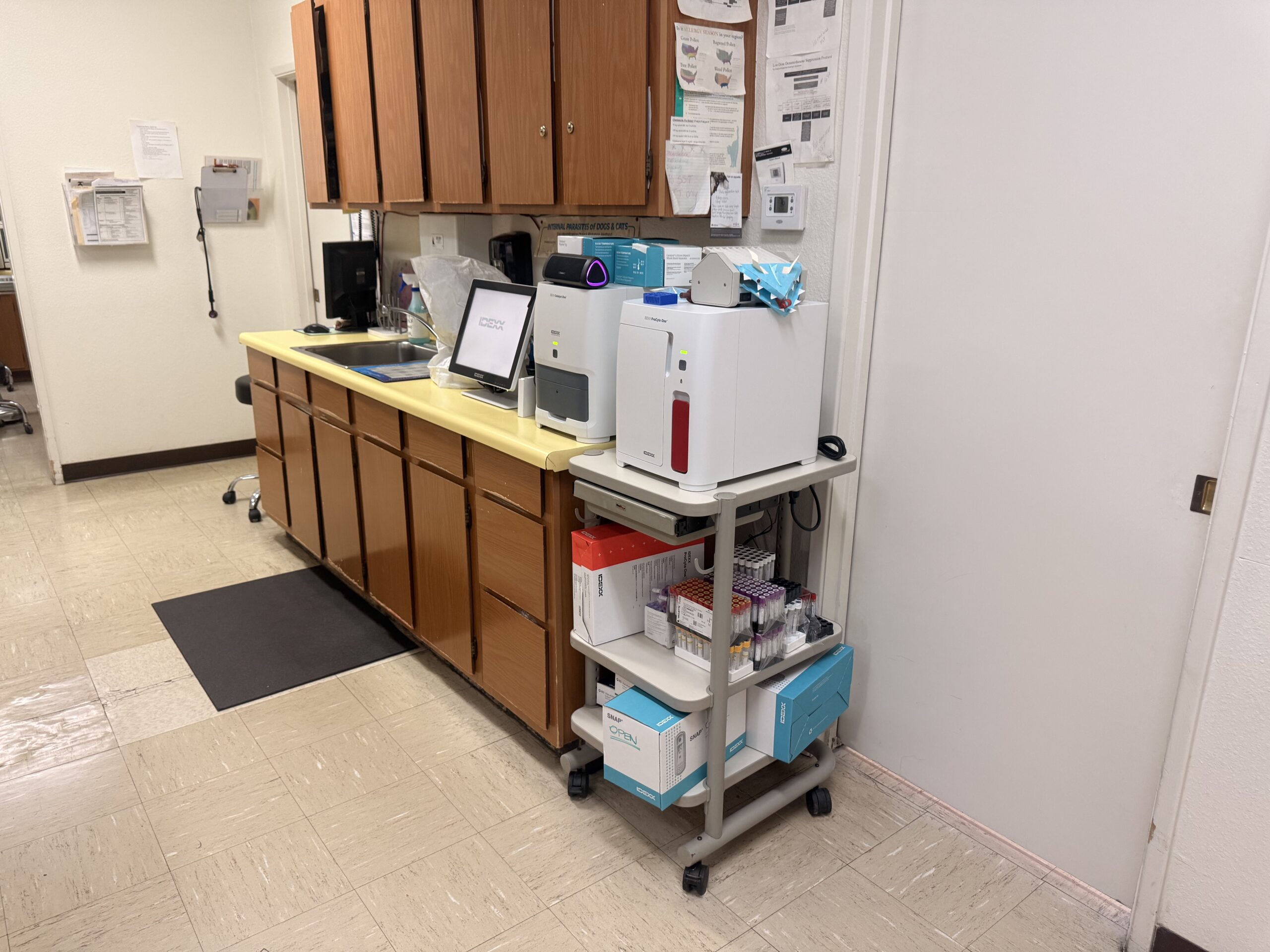
If diagnostic testing is recommended before anesthesia, learn more about in-house veterinary blood work and diagnostics.
If you are new to the hospital, visit our New Client Center to learn what to bring and what to expect at your first visit.
Frequently Asked Questions About Dog and Cat Dental Care
Does bad breath mean my dog needs a dental cleaning?
Persistent bad breath often indicates oral disease, but it does not tell us exactly what condition is present. A veterinary oral examination can help determine whether the problem involves plaque and gingivitis, periodontal disease, an infected tooth, a fractured tooth, an oral mass, or another condition.
My dog has tartar but still eats normally. Can the teeth still hurt?
Yes. Dogs commonly continue eating despite painful periodontal disease or damaged teeth. The fact that a pet is eating does not rule out dental pain.
Can my cat have dental disease without much tartar?
Yes. Cats may have significant oral pain from tooth resorption, periodontal disease, stomatitis, fractured teeth, or other conditions even when the visible teeth do not appear heavily coated with tartar.
Why does my pet need dental X-rays?
Much of each tooth is below the gumline. Intraoral dental X-rays allow veterinarians to evaluate roots, supporting bone, retained roots, fractures, tooth resorption, unerupted teeth, and other disease that cannot be reliably identified by visual examination alone.
Why does veterinary dentistry require anesthesia?
General anesthesia allows the veterinary team to protect the airway, obtain dental X-rays, probe around each tooth, clean beneath the gumline, perform painful treatment without movement or distress, and monitor the patient throughout the procedure.
Is anesthesia-free dental cleaning a good alternative?
No. Anesthesia-free tooth scraping may remove some visible calculus but cannot provide a complete periodontal examination, full-mouth intraoral dental X-rays, reliable cleaning below the gumline, or treatment of painful dental disease. The American Veterinary Dental College does not consider it a replacement for comprehensive veterinary dentistry.
Is my senior dog or cat too old for dental anesthesia?
Age alone does not determine anesthetic suitability. Senior patients should receive an individualized risk assessment that considers medical history, physical examination findings, diagnostic testing, current disease, medications, and the anticipated benefit of treating painful oral disease.
Does every fractured tooth need to be extracted?
No. Treatment depends on the type of fracture, whether the pulp is exposed, the health of the root, the importance of the tooth, and the individual patient. Some teeth may be extracted, while selected teeth may be candidates for endodontic treatment by an appropriately trained veterinarian or veterinary dental specialist.
What is feline tooth resorption?
Tooth resorption is a progressive condition in which a cat’s tooth structure is destroyed. It can be painful and often requires dental radiographs for diagnosis and treatment planning. Treatment depends on the clinical and radiographic type of resorption.
What does swelling under my dog’s eye mean?
Swelling beneath a dog’s eye can occur with an infected upper tooth root, but dental disease is not the only possible cause. Trauma, an oral mass, salivary disease, insect stings, and other conditions can produce similar swelling.
Because the cause cannot be determined reliably from location alone, new facial swelling should be evaluated by a veterinarian rather than treated as a routine dental-cleaning issue.
Why does my cat chatter or jerk its jaw while eating?
Jaw chattering, suddenly pulling away from food, dropping food, or appearing painful while chewing can be signs of feline oral pain.
Tooth resorption is one important possibility, but periodontal disease, stomatitis, fractured teeth, and other oral conditions can cause similar signs. A veterinary oral examination and dental X-rays may be needed to determine the cause.
What dental products should I use at home?
Tooth brushing with pet-safe toothpaste is an excellent foundation for home care. Dental diets, chews, treats, water additives, gels, and other products may also help. Products carrying the Veterinary Oral Health Council Seal have met established criteria for plaque or tartar control.
When is a dental problem an urgent veterinary problem?
Sudden facial swelling, significant oral pain, active bleeding, traumatic injury to the mouth or jaw, or sudden inability to eat normally deserves prompt veterinary evaluation.
Difficulty breathing, major facial trauma, uncontrolled bleeding, collapse, or inability to close the mouth normally may require immediate emergency veterinary care.
Trusted Veterinary Dentistry Resources
- American Animal Hospital Association — Dental Care Guidelines for Dogs and Cats
- American Veterinary Dental College — Animal Owner Resources
- American Veterinary Dental College — Position on Anesthesia-Free Dentistry
- American Veterinary Dental College — Feline Tooth Resorption
- Veterinary Oral Health Council — Accepted Dental Products for Dogs and Cats
- American Veterinary Dental College — Find a Board-Certified Veterinary Dentist
Schedule a Veterinary Dental Examination in Cave Creek
Do not wait until your dog or cat stops eating to ask about dental health.
Persistent bad breath, red or bleeding gums, tartar, facial swelling, broken or discolored teeth, changes in chewing, or an abnormality discovered during a wellness examination are all reasons to have the mouth evaluated.
Earlier diagnosis may allow painful oral disease to be identified and treated before it becomes more advanced or destructive.
Desert Forest Animal Hospital
6554 E Cave Creek Road
Cave Creek, AZ 85331
(480) 488-2010
Learn more about veterinary dental care at Desert Forest Animal Hospital →
New client? Learn what to expect at your first visit →
Medical Review & Editorial Standards
Medically reviewed by Bryan Hayter, DVM
Owner & Medical Director
Desert Forest Animal Hospital
Cave Creek, Arizona
Last medically reviewed: September 2026
This article was reviewed for medical accuracy and is intended to help dog and cat owners recognize signs of oral pain and dental disease, understand the role of dental radiographs and anesthesia, and know when veterinary evaluation may be appropriate.
Clinical dental recommendations are individualized according to the patient’s species, age, breed, oral examination findings, medical history, anesthetic risk, diagnostic imaging, and specific dental or periodontal disease identified.
Our educational content references established veterinary guidance from the American Animal Hospital Association (AAHA), American Veterinary Dental College (AVDC), and Veterinary Oral Health Council (VOHC).
This article provides general educational information and does not replace an oral examination, dental radiographs, diagnosis, or individualized treatment recommendation from a veterinarian who has evaluated your pet. If your pet develops difficulty breathing, major facial trauma, uncontrolled oral bleeding, collapse, or another rapidly worsening condition, seek emergency veterinary care promptly.