


A cough can be minor.
Difficulty breathing is different.
When a dog or cat cannot move air comfortably, respiratory problems can worsen quickly. Knowing the difference between an occasional cough and true respiratory distress can help you decide whether your pet needs a routine appointment, same-day urgent veterinary care, or immediate treatment at a 24-hour emergency hospital.
At Desert Forest Animal Hospital in Cave Creek, we regularly evaluate dogs and cats with coughing, rapid breathing, respiratory noise, exercise intolerance, and other breathing changes. Our independently owned local hospital provides same-day urgent veterinary appointments during regular business hours when availability and the patient’s condition allow, along with in-house laboratory testing and digital diagnostic imaging.
If your pet is actively struggling to breathe, collapsing, turning blue or gray, or unable to settle because of breathing difficulty, do not wait for a routine appointment. Seek emergency veterinary care immediately.
Learn more about same-day urgent veterinary care at Desert Forest Animal Hospital.
Coughing and Difficulty Breathing Are Not the Same Thing
Coughing is a protective reflex. It may originate from irritation or disease affecting the throat, trachea, bronchi, lungs, or sometimes structures around the airways.
A dog that coughs several times but then comfortably walks around the house, eats dinner, and sleeps normally is very different from a dog that is standing with its neck extended and abdomen contracting forcefully with every breath.
Veterinarians use terms such as tachypnea for abnormally rapid breathing and respiratory distress for observable difficulty breathing. “Dyspnea” is also commonly used to describe difficult or uncomfortable breathing.
Merck Veterinary Manual describes signs such as increased respiratory rate, labored breathing, altered breathing posture, open-mouth breathing, and changes in gum color as important indicators of respiratory compromise.
Merck Veterinary Manual: Clinical Signs of Respiratory Disease
Signs Your Pet May Be in Respiratory Distress
Pay attention not just to how fast your pet is breathing, but to how hard they are working to breathe.
Warning signs can include:
- Rapid breathing while resting
- Obvious abdominal effort with each breath
- Open-mouth breathing when it is not expected
- Neck and head extended forward to breathe
- Elbows held away from the chest
- Inability to become comfortable or lie normally
- Persistent wheezing, harsh breathing, or unusual respiratory noise
- Weakness or collapse
- Pale, gray, purple, or blue gums or tongue
- Severe agitation associated with breathing difficulty
- A cat crouching with the neck extended and visibly working to breathe
Gray or blue mucous membranes can indicate severe impairment of oxygenation and require immediate veterinary attention.
Open-Mouth Breathing in Cats Deserves Special Attention
Cats normally breathe quietly through their nose.
A cat experiencing significant respiratory disease may breathe rapidly, extend the head and neck, crouch differently, or begin breathing with the mouth open. Cornell’s Feline Health Center emphasizes that a cat experiencing breathing difficulty should receive veterinary attention promptly because respiratory compromise can become life-threatening.
Cornell Feline Health Center: Difficulty Breathing in Cats
When Should a Cough Be Evaluated?
Not every cough means your pet is experiencing an emergency, but coughing deserves veterinary evaluation when it is persistent, recurrent, worsening, or accompanied by other signs of illness.
Call your veterinarian promptly if coughing occurs along with reduced appetite, lethargy, fever, exercise intolerance, weight loss, abnormal breathing, weakness, or a change in your pet’s usual activity.
A new or worsening cough in an Arizona dog deserves particular attention because several locally important conditions—including Valley Fever—can cause respiratory signs.
If your dog or cat is coughing but breathing comfortably and otherwise stable, call Desert Forest at (480) 488-2010. Depending on current availability and your pet’s condition, we may be able to provide a same-day examination.
What Can Cause Coughing or Breathing Difficulty in Dogs?
There is no single diagnosis called “a cough.”
Possible causes can involve the airways, lungs, heart, chest cavity, blood, or other body systems.
A veterinarian may consider conditions such as infectious respiratory disease, pneumonia, chronic bronchitis, tracheal collapse, laryngeal disease, aspiration, heart disease, pulmonary edema, fluid or air around the lungs, trauma, tumors, severe allergic reactions, anemia, and regionally important fungal infections.
Cornell lists conditions ranging from airway obstruction and laryngeal paralysis to pneumonia, heart disease, pleural fluid, and pulmonary edema among possible causes of canine respiratory distress.
Cornell: Recognizing and Responding to Canine Respiratory Distress
This is why treating a cough without determining its cause can be problematic. A cough suppressant, antibiotic, steroid, diuretic, or other medication that is appropriate for one disease may be ineffective—or inappropriate—for another.
What Can Cause Coughing or Respiratory Distress in Cats?
Cats create an especially important diagnostic challenge because several serious diseases can produce similar outward signs.
Potential causes include feline asthma, pneumonia, heart disease, congestive heart failure, pleural effusion, airway obstruction, tumors, and other pulmonary or systemic disease.
Cornell notes that asthma, heart failure with pulmonary consequences, and fluid around the lungs are among important causes of feline respiratory distress.
That does not mean every coughing cat has asthma—or every rapidly breathing cat has heart disease.
The symptom tells us where to start. It does not tell us where to finish.
Valley Fever: An Important Cause of Coughing in Arizona Dogs
For pets living in Cave Creek, Carefree, Desert Mountain, North Scottsdale, Desert Hills, Terravita, Tatum Ranch, Anthem, and surrounding Sonoran Desert communities, respiratory disease has an important local differential diagnosis: Valley Fever.
Valley Fever, or coccidioidomycosis, develops after susceptible animals inhale fungal spores from the environment.
The University of Arizona Valley Fever Center for Excellence lists coughing, fever, weight loss, poor appetite, and reduced energy among common early signs of pulmonary Valley Fever in dogs. Pneumonia associated with the disease may also become visible on chest X-rays.
University of Arizona Valley Fever Center for Excellence
Because Desert Forest practices in an endemic region, Valley Fever is part of our everyday clinical thinking. Our team has extensive experience combining symptoms, examination findings, Valley Fever testing, laboratory results, and imaging when evaluating suspected cases.
Read our detailed guide to Valley Fever in dogs and cats in Cave Creek.
How We Evaluate a Dog or Cat With Respiratory Symptoms
The first question is not always:
“Which test should we run?”
The first question is:
“Is this patient stable enough for routine diagnostics?”
That distinction matters.
A pet experiencing severe respiratory distress may need immediate stabilization and minimal handling before X-rays or a more extensive examination. Emergency veterinary guidance emphasizes evaluating airway, breathing, and circulation first.
Merck Veterinary Manual: Initial Triage and Resuscitation
A stable coughing patient, by contrast, may be able to proceed directly through a detailed examination and diagnostic workup.
Depending on the patient, evaluation may include:
- Complete medical history and physical examination
- Assessment of breathing pattern and respiratory effort
- Heart and lung auscultation
- STAT CBC and blood chemistry testing
- High-quality digital chest X-rays
- Valley Fever testing when clinically appropriate
- Additional testing based on examination and imaging findings
Learn more about in-house veterinary blood work and diagnostics at Desert Forest.
STAT CBC and Chemistry Testing
Respiratory signs do not always originate solely in the lungs.
A complete blood count can provide important information about red blood cells, white blood cells, and platelets. Severe anemia, infection, or inflammatory changes may contribute to—or help explain—a patient’s symptoms.
A chemistry panel provides additional information about kidney and liver function, glucose, proteins, electrolytes, and other metabolic parameters that may influence diagnosis and treatment.
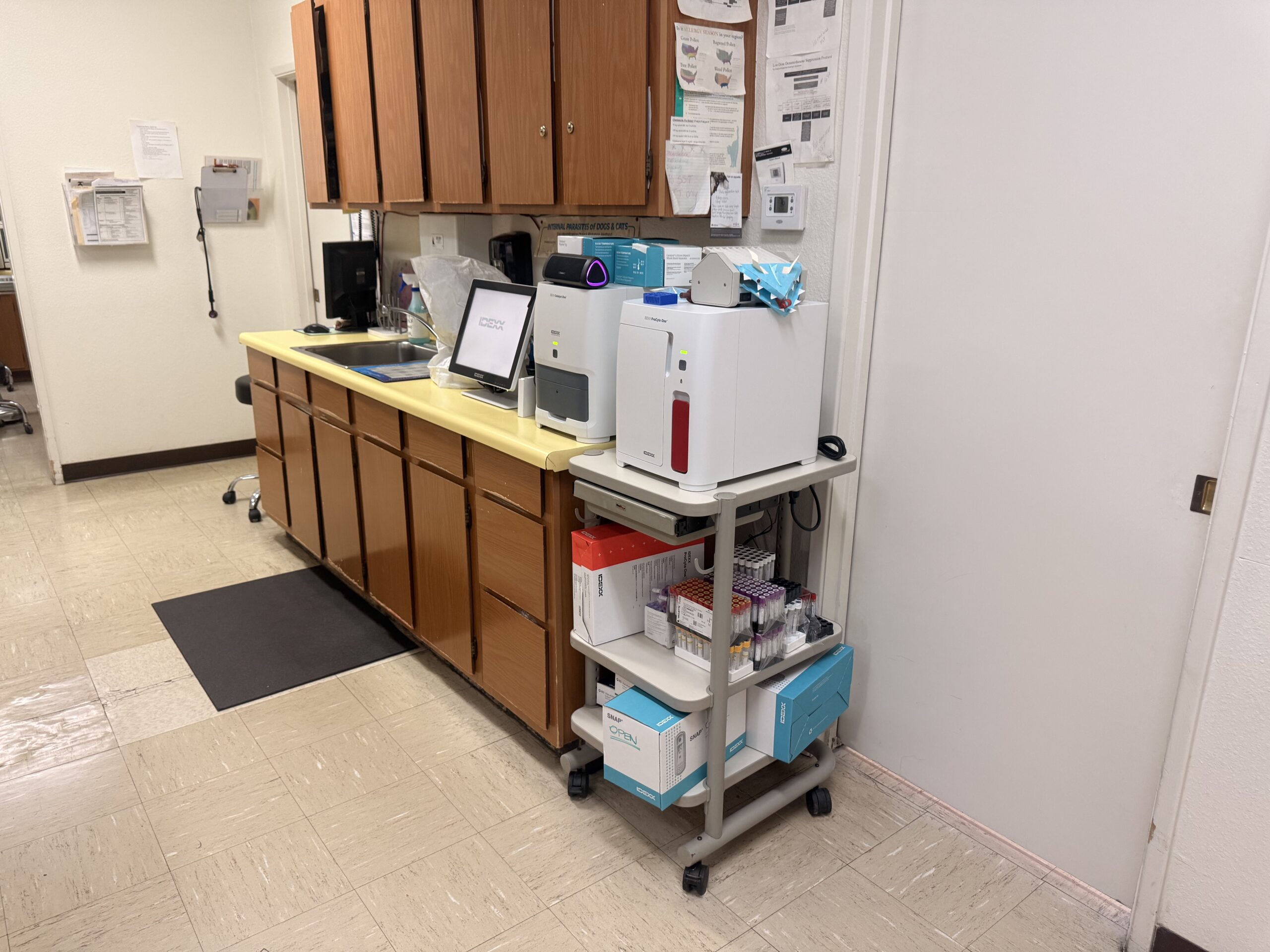
Desert Forest Animal Hospital maintains an in-house laboratory, allowing STAT CBC and chemistry testing to be performed when clinically indicated rather than automatically sending every sample to an outside laboratory.
That can be especially useful when a dog or cat arrives sick and decisions need to be made the same day.
High-Quality Digital Chest X-Rays
Thoracic radiography is one of the most useful diagnostic tools for many coughing and respiratory patients.
Chest X-rays may help veterinarians evaluate the lungs, airways, heart silhouette, chest cavity, and other structures. Merck notes that thoracic radiographs are recommended in patients showing signs of lower respiratory disease such as coughing, rapid shallow breathing, or difficulty breathing—when the patient is stable enough for imaging.
Merck Veterinary Manual: Diagnostic Techniques for Respiratory Disease
Desert Forest Animal Hospital has high-quality digital veterinary X-ray capability on site. Images can be captured and reviewed during the visit, avoiding the delays associated with traditional film processing.
Learn about our digital veterinary radiology and X-ray services.
Board-Certified Veterinary Radiology Consultation
Some chest X-rays are straightforward.
Others are not.
Subtle pulmonary patterns, changes around the heart, unusual masses, complicated pneumonia, pleural disease, or overlapping abnormalities can benefit from specialist interpretation.
When medically indicated, Desert Forest can submit digital studies for rapid or STAT consultation with a board-certified veterinary radiologist, subject to specialist availability.
The American College of Veterinary Radiology explains that board-certified veterinary radiologists undergo advanced postgraduate training specifically in diagnostic imaging.
American College of Veterinary Radiology: Information for Pet Owners
For us, having sophisticated imaging does not mean every patient automatically needs X-rays or specialist review.
It means that when imaging can answer an important question, we want the image and its interpretation to be as useful as possible.
Fear Free Principles Matter Even During an Urgent Visit
Respiratory patients can become significantly worse when frightened or excessively restrained.
A frightened animal may breathe faster, struggle harder, and expend additional energy at exactly the time we want to reduce unnecessary respiratory effort.
Dr. Quinn Bauer, DVM is a Fear Free Certified veterinarian at Desert Forest Animal Hospital. She incorporates behavior-aware handling into sick and urgent visits whenever the patient’s condition permits.
That may mean reducing unnecessary restraint, modifying positioning, minimizing stimulation, organizing diagnostics efficiently, controlling pain, or considering sedation when it provides the safest and most humane approach.
But there is an important qualification:
Fear Free care never means delaying life-saving treatment.
If a pet is experiencing severe respiratory distress, shock, or another critical emergency, immediate stabilization takes priority.
Learn more about Fear Free veterinary care at Desert Forest Animal Hospital.
What Should You Do While Driving a Pet With Breathing Difficulty to the Veterinarian?
Stay as calm as possible and minimize unnecessary handling.
Call the veterinary hospital while you are preparing to leave or while another person drives, if possible. Calling ahead allows the team to understand what is happening and prepare—or tell you if proceeding directly to a 24-hour emergency hospital is safer.
For a dog experiencing respiratory distress, Cornell recommends keeping the vehicle cool because heat and heavy panting can further increase respiratory effort.
Do not force food, water, or oral medication into an animal that is struggling to breathe. Do not make a weak pet walk unnecessarily.
And do not delay leaving in order to count breaths, take repeated videos, or search the internet if your pet is clearly struggling for air.
Same-Day Urgent Care or 24-Hour Emergency Hospital?
This is one of the most important distinctions in this article.
Desert Forest Animal Hospital provides same-day urgent veterinary care and emergency triage during regular business hours when staffing, case volume, and the patient’s medical condition allow.
A stable dog with a new cough, a cat with intermittent coughing but normal breathing between episodes, or a pet with a respiratory change that needs evaluation today may be appropriate for same-day assessment at Desert Forest.
A pet with severe breathing difficulty, blue or gray gums, collapse, profound weakness, or rapidly deteriorating respiratory function should be treated as an emergency.
AAHA identifies difficulty breathing as an emergency sign and specifically notes gasping, wheezing, excessive panting, noisy breathing, and abnormal gum color among concerning respiratory findings.
AAHA: Is This a Pet Emergency?
If you call Desert Forest and the symptoms you describe suggest your pet needs intensive or 24-hour emergency resources, we would rather direct you immediately to the appropriate facility than delay your pet’s care simply to have you come through our door first.
That is part of good triage.
A Local, Independent Veterinary Hospital With Modern Diagnostic Capability
Desert Forest Animal Hospital has cared for pets in Cave Creek since 1984 and remains a locally operated, independently owned veterinary hospital.
We believe independence and high-quality medicine should complement each other.
Our clients can receive the personal attention and continuity associated with a community veterinary hospital while still having access to capabilities that matter when an animal suddenly becomes sick:
- Same-day urgent evaluation when available
- In-house STAT CBC and chemistry testing
- High-quality digital radiography
- Rapid board-certified radiology consultation when indicated
- Valley Fever expertise
- Individualized Fear Free-informed care
Our goal is not simply to run more tests.
It is to identify which information matters, obtain it efficiently, and use it to make a thoughtful medical decision for the individual patient.
Learn more about Desert Forest Animal Hospital and our history in Cave Creek.
Respiratory Care for Cave Creek, Carefree, Desert Mountain and North Scottsdale Pets
Our Cave Creek hospital sees dogs and cats from throughout the surrounding North Valley, including Cave Creek, Carefree, Desert Mountain, North Scottsdale, Terravita, Tatum Ranch, Dove Valley Ranch, Desert Hills, Anthem, and nearby Sonoran Desert communities.
Local geography matters in respiratory medicine.
A dog living in Arizona has different environmental and infectious exposures than a dog living in Maine or Minnesota. Travel history matters. Dust exposure matters. Hiking and outdoor activity may matter. Valley Fever belongs much higher on the diagnostic list here than it would in much of the country.
That local experience is one reason we encourage new Arizona residents to tell us where their pet previously lived and where they travel.
Frequently Asked Questions About Coughing and Breathing Problems
My dog coughed a few times. Is that an emergency?
Not necessarily. An occasional cough in a comfortable dog is different from respiratory distress. Persistent, worsening, or recurrent coughing should be discussed with a veterinarian. Coughing accompanied by rapid or difficult breathing, weakness, collapse, or abnormal gum color is much more urgent.
How can I tell whether my dog is having trouble breathing?
Watch for abdominal effort, unusual posture, extended head and neck, inability to settle, abnormal respiratory noises, weakness, collapse, or a visible increase in effort with every breath.
Is open-mouth breathing normal in cats?
Open-mouth breathing in a cat—particularly at rest or when accompanied by increased respiratory effort—is concerning and can represent a medical emergency. Seek veterinary care promptly.
Can Valley Fever cause coughing?
Yes. Pulmonary Valley Fever commonly causes coughing and may also cause fever, fatigue, weight loss, and poor appetite. More severe pulmonary disease can cause difficulty breathing.
Can heart disease cause breathing problems?
Yes. Heart disease can lead to fluid accumulation within or around the lungs and produce respiratory distress. Other lung, airway, and systemic diseases can cause similar symptoms, which is why veterinary evaluation is important.
Will my pet automatically need chest X-rays?
No. The veterinarian first determines whether imaging is medically appropriate and whether your pet is stable enough to undergo it. In a severely compromised respiratory patient, stabilization may need to happen first.
Can Desert Forest perform blood work the same day?
Yes. Desert Forest maintains an in-house laboratory and can perform commonly needed CBC and chemistry testing during urgent evaluations when medically indicated.
Can a radiologist review my pet’s X-rays?
When indicated, our digital studies can be submitted for consultation with a board-certified veterinary radiologist, including rapid review when available.
Does Desert Forest see respiratory cases the same day?
Yes, when staffing, current patient volume, and the pet’s medical condition allow. Call (480) 488-2010 before coming in. If the symptoms suggest an unstable or life-threatening respiratory emergency, we may recommend proceeding directly to a 24-hour emergency hospital instead.
Concerned About Your Pet’s Breathing? Call Before You Come
If your dog or cat has developed a new cough, abnormal breathing, respiratory noise, or another sudden health change, call Desert Forest Animal Hospital at (480) 488-2010.
Same-day urgent appointments are available during regular hospital hours when availability and the patient’s condition allow.
Desert Forest Animal Hospital
6554 E Cave Creek Road
Cave Creek, Arizona 85331
Monday–Friday: 9:00 a.m.–6:00 p.m.
Saturday: Closed
Sunday: Closed
CALL (480) 488-2010 | URGENT CARE INFORMATION | NEW CLIENT INFORMATION
Medically reviewed by Bryan Hayter, DVM
Owner & Medical Director, Desert Forest Animal Hospital
Doctor of Veterinary Medicine, Auburn University
Fear Free content reviewed by Quinn Bauer, DVM
Fear Free Certified Veterinarian
Doctor of Veterinary Medicine, Midwestern University
Last medically reviewed: September 2026
Desert Forest Animal Hospital has served the Cave Creek community since 1984. This article provides general educational information and cannot determine the severity of an individual pet’s breathing problem. Respiratory distress can become life-threatening rapidly. If your pet appears unable to breathe comfortably, seek veterinary care immediately.